
The importance of iodine in human diets is well understood, but despite over 100 years of research, little is known about how iodine impacts plants. Prior research has shown that the addition of exogenous iodine has led to a variety of responses based on species (and even varieties), application timing, the form of iodine, and the rate. Documented responses of most interest to this research are: increased stress tolerance and altered bloom timing. This research seeks to determine how the addition of iodine at varying times and through various application methods impacts almond, pistachio and avocado trees during bloom. At this stage of the project, which looks only at almond, we have developed a novel method to analyze and compare treatments in floral progression. This is done at the spur level by using non-linear least square model fitting in R, and at the tree level using raster calculations in ArcGIS on fixed wing, multi-spectral, high temporal resolution imagery. These data show that the application of iodine to almond spurs at the pink-bud stage is leading to more earlier and concentrated flowering with a commensurate 5% increase in fruit set, albeit that these results are statistically insignificant due to the high natural variance. A whole-tree foliar pink-bud application experiment in 2024 has confirmed the timing trend seen in spurs, but it will be necessary to wait until harvest to see if there is any increase in yield. Further work is ongoing to determine if the bloom dynamics noted are evidence of improved pollination due to iodine (mechanism unknown), or because of temporal variability in pollinator availability due to the altered peak bloom date. In the former case, we would expect a benefit each season, whereas in the latter, any benefit would be seasonally dependent.
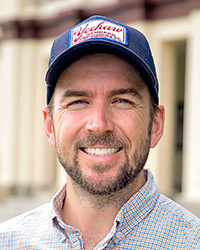
Daniel Ostrowski won the ISHS Young Minds Award for the best oral presentation at the X International Symposium on Plant Nutrition of Fruit Crops in the USA in June 2024.
Daniel Ostrowski, University of California, Davis, One Shields Avenue, Davis, CA 95616, USA, e-mail: drostrowski@ucdavis.edu
The article is available in Chronica Horticulturae