
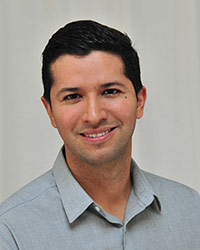
Martin Zapien is a PhD student in the Small Fruit Horticulture Lab at the University of Florida, USA. Martin’s research focuses on agronomic strategies to increase the efficiency of southern highbush blueberry (SHB) production in north-central Florida. Specifically, Martin’s research explores how pruning practices can be used to concentrate fruit ripening and increase harvest efficiency. Blueberries exhibit asynchronous ripening, which results in extended harvesting periods. Accelerating and synchronizing fruit ripening depends on photosynthetically active radiation (PAR) availability, which is influenced by plant architecture and canopy attributes. In the awarded oral presentation, the objective was to document PAR interception and distribution within the canopy of mature, deciduous SHB plants, as they emerge from dormancy and enter the fruiting season. Results demonstrated that PAR distribution varied significantly within the plant canopy. Approximately, 50% more PAR light was available to leaves located 1.2 m from the base of the plant than at 0.6 m. Monthly variability in PAR interception was also observed between cultivars, reflecting differences in plant architecture. These findings suggest that photosynthesis in the lower part of the SHB canopy might be limited by PAR scarcity. Light interception differences could also impact other traits of interest like fruit ripening, quality and yield.
Martin Zapien won the ISHS Young Minds Award for the best oral presentation at the XIII International Vaccinium Symposium in Canada in August 2024.
Martin Zapien, University of Florida, 2550 Hull Rd., Gainesville, FL 32611, USA, e-mail: jzapienmacias@ufl.edu
The article is available in Chronica Horticulturae