
In this study, we focused on UV-B irradiation (280-320 nm) as a novel disease control method as an alternative to synthetic fungicides. Previous studies have reported that UV-B irradiation is effective in controlling powdery mildew (Podosphaera pannosa) in roses. To optimize the irradiation method to treat rose powdery mildew, we cultivated roses using UV-B irradiation in greenhouses. At low levels of UV-B irradiation, powdery mildew was suppressed, but at high irradiation intensity, rose leaves were damaged. UV-B irradiation induces DNA damage, leading to the formation of cyclobutane pyrimidine dimers (CPD). These lesions act as an obstacle for the progression of DNA replication and transcription processes. The major pathways to remove CPD from the genome are nucleotide excision repair and DNA repair by photolyase in the presence of light. We examined the optimal UV-B irradiation treatment for controlling rose powdery mildew by investigating the amount of CPD formation through UV-B irradiation at different irradiation times and time periods. When irradiated for different time lengths (from 0-3.5 h), CPD level increased gradually according to the duration of irradiation. Night-time irradiation resulted in more than twice as much CPD formation as in the non-irradiated control. In daily irradiation for 1 h during the dark period, there was a significant increase in CPD formation after 7 and 14 days. CPD levels under dark periods exceeded the repair of CPDs under light and dark conditions, resulting in CPD accumulation under daily UV-B irradiation. To investigate dark repair of CPDs, we irradiated leaves infected with Podosphaera pannosa for 1 h during the dark period and incubated them for 0-5 h in the dark. CPD formation increased immediately after irradiation and then slowly decreased in the dark period, suggesting that dark repair was taking place in Podosphaera pannosa. This study will continue to optimize irradiation methods to control Podosphaera pannosa in rose cultivation.
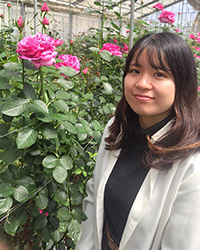
Honami Nakasuji won the ISHS Young Minds Award for the best poster presentation at the IX International Symposium on Rose Research and Cultivation in China in May 2025.
Honami Nakasuji, Graduate School of Agriculture, Kindai University, 3327-204, Nakamachi, Nara-shi, Nara, 631-0052, Japan, e-mail: 2433650019s@nara.kindai.ac.jp
The article is available in Chronica Horticulturae