
An occasional series highlighting the life and work of members of our vibrant global community of horticultural scientists.
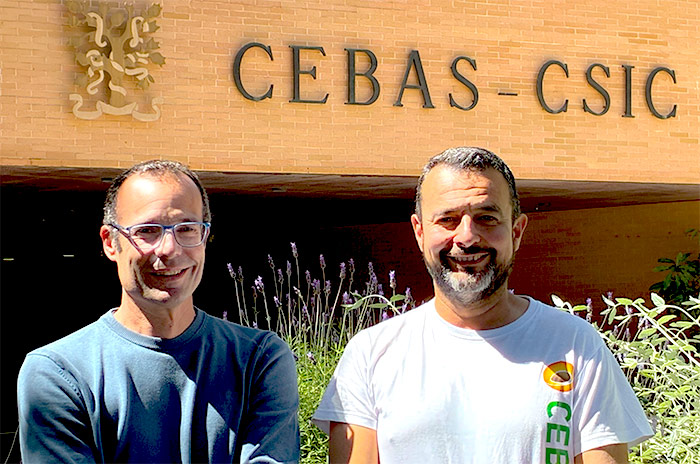
Dr. Manuel Rubio (right), Head of the Fruit Breeding Group at CEBAS-CSIC, and Dr. David Ruiz (left), Responsible for Apricot and Plum Breeding Programs at CEBAS-CSIC, are the conveners of the II International Symposium on Apricot and Plum, to be held on May 3-7, 2027 in Murcia, Spain, under the aegis of the International Society for Horticultural Science (ISHS).
Both have worked in stone-fruit breeding for over 25 years at the Murcia’s Center for Soil Science and Applied Biology of the Segura River (CEBAS), part of the Spanish National Research Council (CSIC).
What attracted you to the field of horticulture?
We met at university 30 years ago, studying agronomy. We grew up in a region where agriculture is very important, so there are a lot of professional opportunities for people with skills in different aspects related to horticulture, like biology, chemistry, engineering, and, of course, agronomy.
Our motivation is to contribute knowledge and innovation to the agricultural sector (such as new fruit varieties) to improve its sustainability and profitability.
What are you working on at the moment?
Currently, we are working on several aspects of breeding, focusing on implementing omics technologies (genomics, transcriptomics, etc.) to improve and optimize the breeding process with the ultimate goal of obtaining new, improved apricot, plum and almond varieties.
What’s your favourite thing about your job?
In our case, we both love to spend time in the field, characterizing offspring, taking notes of multiple key aspects of fruit tree performance. David explores adaptation to climatic conditions, floral biology and fruit quality while Manuel is investigating phenotyping against different pathogens.
Tell us a bit about your symposium?
Apricot and plum culture and breeding is a really international subject and specialists in similar areas must have a chance to meet and collaborate. International symposia really enhance a specialist’s awareness of various approaches to growing the same crop in different parts of the world. It’s great to see young scientists and researchers gain a fresh perspective on the problems and potential.
In our own area of fruit breeding, we’re sure we’ll be discussing genomics, new molecular tools, genetic resources, fruit quality, and emerging diseases.
What are you particularly looking forward to?
We are working to create a forum for knowledge exchange and professional development, so while it is always great to meet old friends, the best thing is seeing new people and knowing they will get a lot from the symposium and leave with new ideas and enthusiasm for their research.
In addition, it is always a pleasure to show foreigners our region, the city and the local food specialties, as well as the advanced production systems of Murcia’s agriculture. We would like symposium participants to take home a general idea of what’s going on in Apricot and Plum around the world, and of course, memories of their visit to this little-known corner of Spain.
What are your plans for future research?
We are focusing on advancing research in fundamental aspects of stone fruit breeding and on increasing the efficiency of breeding programs.
For example, via the routine use of new genomic tools and the implementation of hyperspectral imaging for high-throughput phenotyping, which we believe will allow us to collect, in a non-destructive way, a large amount of information about key aspects of phenology, fruit quality, and plant health, among others. In addition, we are studying the adaptation of Prunus species in the new climate context of global warming, which seriously affects temperate fruit production areas.
We hope to see you in Murcia!
Register for the symposium: https://ishs.org/symposium/870/
Not a member? Join our global community of horticultural scientists.