
An occasional series highlighting the life and work of members of our vibrant global community of horticultural scientists.
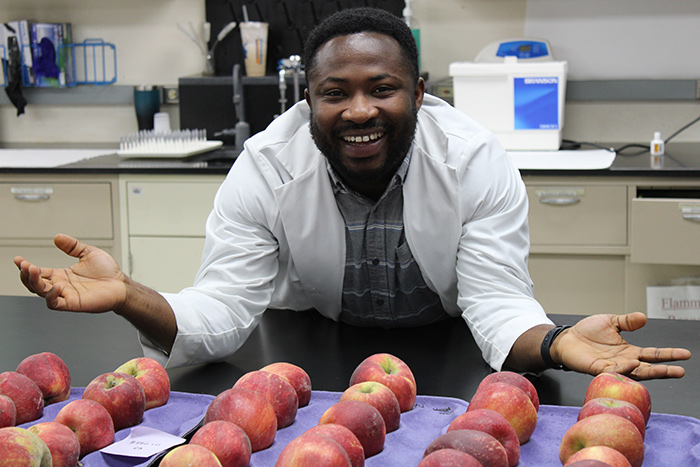
Sadat Amankona, winner of the ISHS Young Minds Award for the best poster presentation at the XIV International Controlled and Modified Atmosphere Research Conference, works on non-chemical strategies and the storage of organic apples.
What attracted you to the field of horticulture?
My passion for horticulture was cultivated on my father’s farms in the Bono region of Ghana, Abesim and Adrobaa to be precise. Growing up, I watched him manage his vegetables, fruits and plantations as a small scale grower. He produced tomatoes, onions, cucumbers, mangoes, cashews, and cocoa among others. What truly intrigued me was when he allowed me operate his irrigation systems; that early hands-on experience turned a childhood curiosity into a lifelong academic pursuit.
What’s your favorite thing about your job?
I find the bridge between the field, lab and the data incredibly rewarding. I specifically enjoy fruit quality evaluations and data analysis. It is fascinating to see how specific treatments translate into measurable quality improvements, especially knowing that this research will provide long-term economic and sustainable benefits to the US organic apple industry.
Can you tell us a bit about your research?
With the demand for organic apples rising exponentially in the US, we need alternatives for long term storage of apples because synthetic chemicals are prohibited in organic systems. My research focuses on using non-chemical approaches to optimize the storage of ‘Gala’ and ‘Honeycrisp’ apples. I am investigating the use of dynamic controlled atmosphere (DCA) storage and postharvest hot water treatments (49 and 52°C for 2 minutes) to inactivate decay-causing pathogens before the fruit enters cold storage.
What was it like to give a presentation at a symposium?
It was an invaluable opportunity to share my research findings with the scientific community and industry stakeholders. The real-time feedback and networking were immense, but the highlight was certainly receiving the ISHS Young Minds Award for best poster presentation. It was a proud moment to have my work recognized by peers in the field.
What are your plans for future research?
As I complete my PhD this year, my goal is to transition into a role where I can apply my expertise in postharvest physiology and sustainable agriculture. Whether through research, extension, or industry collaboration, I am committed to advancing food security and contributing my quota to the next generation of horticultural innovation.
Not a member? Join our global community of horticultural scientists.